By Barron Greenwalt, Pastor at En-Joy Ministries | October 07, 2025
Study on Acts 17:16-34 for En-Joy Ministries
When the Apostle Paul stepped into Athens, he entered a city pulsating with intellectual vigor, religious fervor, and cultural pride. Acts 17:16-34 captures a pivotal moment in Paul’s missionary journey, where he engages the Athenians in a way that challenges their worldview while pointing them to the one true God. This passage offers rich insights for us today as we navigate a world filled with competing ideologies and spiritual hunger. Let’s dive into this narrative, exploring Paul’s stirred spirit, the philosophical landscape, the religious context of Athens, and the profound truths about God’s creation and humanity’s unity that Paul proclaimed.
A Stirred Spirit in a City of Idols (Acts 17:16)
As Paul wandered the streets of Athens, “his spirit was stirred” (Acts 17:16, KJV) at the sight of a city wholly given over to idols.
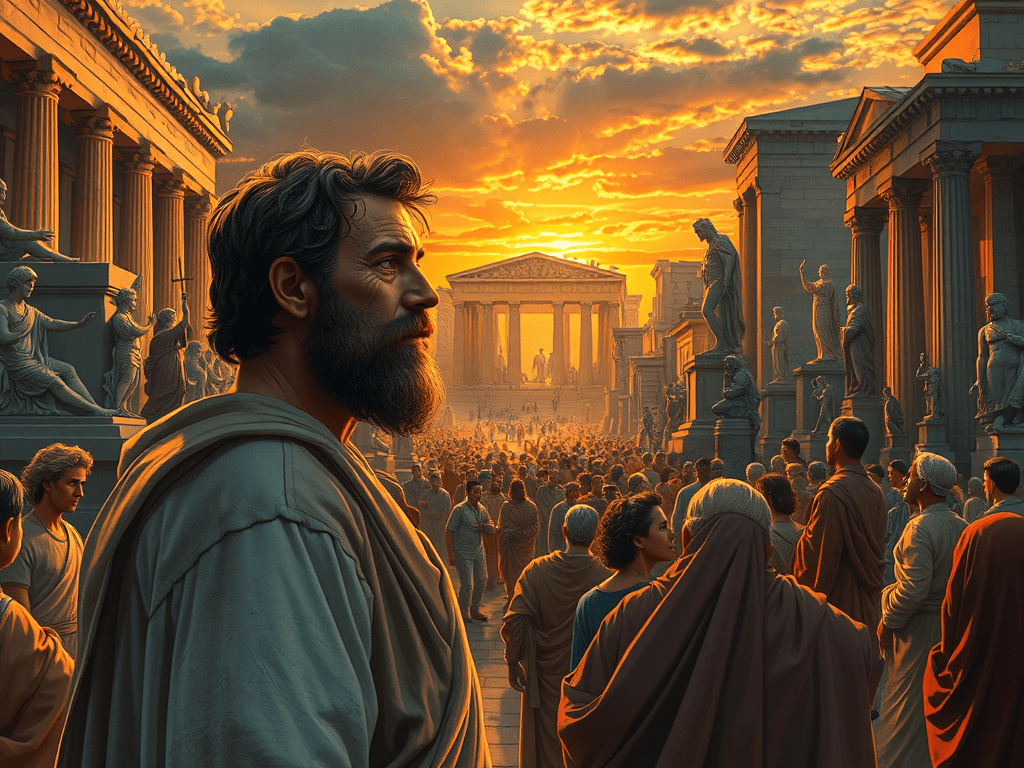
This wasn’t mere annoyance or curiosity; the Greek word paroxyneto suggests a deep, gut reaction—part righteous anger, part compassionate grief. Paul, a monotheist rooted in the worship of the one true God, was confronted with a dazzling array of temples, altars, and statues dedicated to countless deities. Athens was a visual symphony of idolatry, with more statues of gods than in all of Greece combined, as some ancient sources suggest. This stirred Paul’s heart, not because he was judgmental, but because he saw a people seeking meaning in creations of their own hands, blind to the Creator who gives life to all.
For us, this raises the question: What stirs our spirits today? Are we moved when we see people chasing after modern “idols”—whether materialism, fame, or ideologies that promise fulfillment but deliver emptiness? Paul’s response wasn’t to condemn but to engage, offering a bridge to the truth. Let’s consider how we, too, can respond with compassion and boldness in a world seeking answers.
Philosophers and Seekers: Epicureans and Stoics (Acts 17:18)
Paul’s message drew the attention of the Epicurean and Stoic philosophers, two prominent schools of thought in Athens.
The Epicureans, followers of Epicurus, believed life’s purpose was to pursue pleasure and avoid pain, viewing gods as distant and uninvolved. The Stoics, influenced by Zeno, emphasized self-control, reason, and living in harmony with nature’s rational order. Both groups were curious about Paul’s preaching of Jesus and the resurrection, yet some mocked, calling him a “babbler” (Acts 17:18). To them, Paul’s message was strange, even foolish—a Jewish preacher speaking of a risen Savior in a city obsessed with intellectual sophistication.
This encounter reminds us that sharing the Gospel often means engaging with diverse worldviews.
The Epicureans and Stoics represent timeless human tendencies: seeking pleasure or self-reliance apart from God. Paul didn’t shy away from these perspectives but met them on their turf, reasoning in the synagogue and marketplace (Acts 17:17). How can we, like Paul, engage thoughtfully with the philosophies of our day, pointing people to the hope of Christ?
Athens: The Religious Epicenter (Acts 17:22)
When Paul stood on Mars Hill (the Areopagus), he addressed the Athenians as “very religious” (Acts 17:22). This wasn’t a compliment but a neutral observation, perhaps tinged with irony. The Greek term could imply “somewhat superstitious,” reflecting Athens’ obsession with covering all spiritual bases, including an altar “to the unknown god” (Acts 17:23). As the religious center of the Greco-Roman world, Athens boasted more gods than anywhere else, with estimates suggesting tens of thousands of statues adorned the city. This hyper-religiosity revealed a deep spiritual hunger, yet it was misdirected toward lifeless idols.
Paul seized this opportunity, proclaiming the God who doesn’t dwell in temples made by hands (Acts 17:24). His approach teaches us to find common ground with others, even in their misconceptions, and redirect their spiritual curiosity toward the truth. In our pluralistic world, how can we lovingly point people to the God who is not unknown but knowable through Christ?
The God of Creation and the Unity of Humanity (Acts 17:26-29)
At the heart of Paul’s message is a profound declaration about God’s sovereignty and humanity’s unity. In Acts 17:26-29, he states that God “hath made of one blood all nations of men for to dwell on all the face of the earth” (Acts 17:26, KJV). This truth, rooted in both Old and New Testaments, affirms that all humanity—every ethnicity, nationality, and culture—shares a common origin. From Adam and Eve to the sons of Noah, Scripture traces the human family to a single source, created by the one true God (Genesis 1-11). The prophet Malachi echoes this, asking, “Have we not all one father? hath not one God created us?” (Malachi 2:10, KJV).
Paul’s words in Acts 17:26 underscore the unity and equal worth of all people. Because God created us from “one blood,” no group is superior or inferior; all bear His image (Genesis 1:26-27). This was radical in a Greco-Roman world stratified by class, ethnicity, and status. Paul further declares that we are God’s “offspring” (Acts 17:28-29), quoting Greek poets to affirm that our existence and worth are rooted in Him. This divine connection gives every person inherent dignity and a divine destiny—to know and worship the Creator.
For us, this truth is a call to celebrate humanity’s unity and worth. In a world divided by race, politics, or culture, the Gospel reminds us that all people are equal before God, deserving of respect and love. Our divine destiny is to live in fellowship with Him, reflecting His image and fulfilling His purposes. How can we embody this unity in our communities, churches, and ministries?
A Call to Repentance and Righteous Judgment (Acts 17:30-31)
Paul’s message increases with a bold call: God “now commandeth all men everywhere to repent” (Acts 17:30, KJV) because He has appointed a day to “judge the world in righteousness” by Jesus, whom He raised from the dead (Acts 17:31). Unlike his other sermons, Paul doesn’t quote Hebrew Scriptures, which his Greek audience wouldn’t know. Instead, he appeals to their reason and conscience, pointing to the resurrection as evidence of God’s ultimate authority.
This call to repentance is universal—God commands all to turn from sin and idols to the living God. The promise of righteous judgment assures us that God’s justice will prevail, offering hope in a broken world. Yet, it also challenges us to examine our own lives. Are we living in light of God’s coming judgment, aligning our hearts with His righteousness?
Meager Results, Enduring Lessons
Curiously, Paul’s ministry in Athens yielded “meager” results compared to other cities. No baptisms are recorded, no church is established, and no New Testament letter addresses the Athenians. Only a few believed, including Dionysius and Damaris (Acts 17:34). Why? We don’t know fully, but perhaps the Athenians’ intellectual pride or spiritual saturation made them resistant. Unlike Corinth or Thessalonica, where the power of God was evident in miracles and conversions, Athens remained a tough field. Yet, Paul’s faithfulness shines through. He didn’t measure success by numbers but by obedience to proclaim the truth. This encourages us to share the Gospel boldly, trusting God with the results, even when they seem small.
Application for Today
As we study Acts 17:16-34, let’s reflect on Paul’s example and the timeless truths he shared:
- Be stirred. Let the spiritual lostness around us move us to compassion and action, not judgment.
- Engage thoughtfully. Like Paul, meet people where they are, using their language and culture to point to Christ.
- Celebrate humanity’s unity. Embrace the truth that all people, created in God’s image, share one blood and divine worth.
- Proclaim repentance and hope. Call others to turn to God, trusting in His righteous judgment and the resurrection of Jesus.
For En-Joy Ministries, this passage is a reminder of our mission to spread joy through the Gospel, uniting people across divides and pointing them to their divine destiny in Christ. May we, like Paul, be stirred to share the good news in our own “Athens,” trusting God to work through us.
Study Questions for Your Group
- What stirs your spirit when you see the “idols” of our culture? How can we respond with compassion and truth?
- How can we engage with people of different worldviews, like the Epicureans and Stoics, in a way that points to Jesus?
- What does it mean for us today that God made all nations “of one blood”? How can we reflect this unity in our lives?
- Paul called the Athenians to repent in light of God’s judgment. How does this challenge us in our walk with Christ?
- Why do you think Paul’s ministry in Athens had limited results? What can we learn from his faithfulness?
Prayer
Heavenly Father, thank You for creating us in Your image and called to know You. Stir our spirits to see the world as Paul did, with compassion and boldness. Help us proclaim Your truth in love, trusting You with the results. May we live out the unity and worth You’ve given us, bringing joy and hope to others through Your Son, Jesus. Amen.
Please consider Supporting En-Joy Ministries
En-Joy Ministries cultivates the joy of the Lord as a source of spiritual strength, rooted in scripture. Your donation empowers our mission to make disciples through biblical teaching, community outreach, farm-fresh giving, and meals for those in need. Help us spread the gospel and nurture mature believers who live out their faith. Every gift supports our work to enrich lives with God’s love. Thank you for partnering with us!
Discover more from En-Joy Ministries
Subscribe to get the latest posts sent to your email.
