
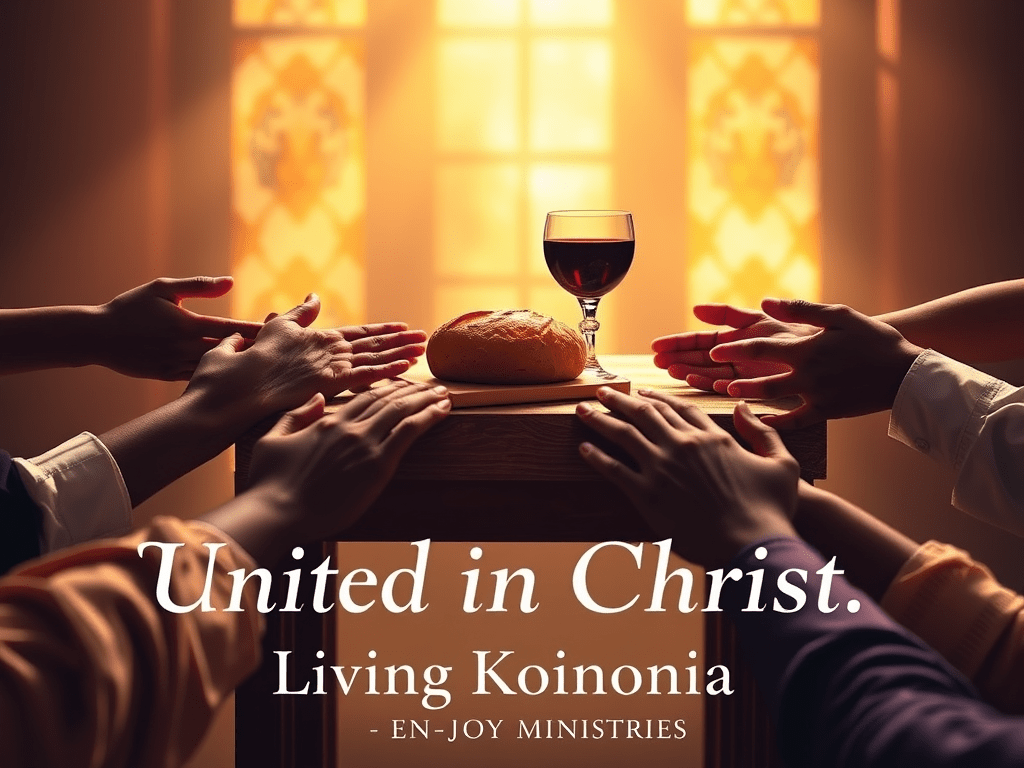
Dear En-Joy Ministries family, as your pastor, I invite you to reflect on the sacred beauty of communion and the deep fellowship we share in Christ. At the heart of our journey is koinonia, a Greek word that captures the intimate spiritual bond of fellowship, communion, and shared life among believers and with our Savior. Rooted in scriptures like Acts 2:42-47, Matthew 26:17-29, and 1 Corinthians 10:16-17, we’ll explore how communion unites us, centers our hearts on Jesus’ sacrifice, and strengthens our witness as God’s beloved community. Join me in embracing koinonia as we grow together in faith, love, and purpose, glorifying God in all we do.
The Church: A Family United in Christ
In God’s design, the church is not a building but a family of believers we belong to (Ephesians 1:5). When we place our faith in Jesus, we’re adopted into His family, belonging not only to God but to each other. Like a healthy earthly family, the church offers love, encouragement, guidance, and accountability. As God’s family, we grow, celebrate, serve, and share life together, becoming stronger followers of Jesus (Galatians 3:28).
This unity is vividly displayed in Koinonia, the intimate spiritual communion that binds us. As Amos 3:3 asks, “Can two walk together, unless they are agreed?” True fellowship requires like-mindedness, rooted in our shared faith in Christ. Through the Holy Spirit, who dwells in all believers (John 14:17), we experience a fellowship unlike any other, made possible only through Jesus’ sacrifice (1 John 1:6-7; Colossians 1:21).
Koinonia in Action: The Early Church
Acts 2:42-47 beautifully illustrates koinonia in the early church:
“They devoted themselves to the apostles’ teaching and to fellowship, to the breaking of bread and to prayer. Everyone was filled with awe… All the believers were together and had everything in common… They broke bread in their homes and ate together with glad and sincere hearts, praising God and enjoying the favor of all the people. And the Lord added to their number daily those who were being saved.” (NIV)
Empowered by the Holy Spirit, these believers devoted themselves to God’s Word, prayer, fellowship, and breaking bread. The word koinonia here signifies deep spiritual unity with God and each other. They were “together,” “of one accord,” and shared “all things in common,” embodying a unity so powerful that it drew others to Christ daily. This passage reminds us that there is strength in unity, as believers function as one body, each member vital to the whole (1 Corinthians 12:12-27).
Communion: A Sacred Act of Togetherness
Communion, or the Lord’s Supper, is a profound expression of koinonia. On the night before His crucifixion, Jesus shared a Passover meal with His disciples, transforming it into a lasting symbol of His sacrifice (Matthew 26:17-19, 26-28). He took bread, saying, “This is my body, broken for you,” and the cup, declaring, “This is my blood, poured out for many for the forgiveness of sins” (NIV). Jesus, the Lamb of God (John 1:29), offered Himself to deliver us from spiritual death, just as the Passover lamb spared the Israelites (Exodus 12:23).
This shared meal focuses our hearts on Jesus’ sacrifice, demonstrating God’s love for us (Romans 3:23-26; 1 John 2:2). It’s not a ritual but an act of worship that unites us as one body. As 1 Corinthians 10:16-17 states, “The bread that we break, is it not a sharing in the body of Christ? Because there is one bread, we who are many are one body, for we all partake of the one bread” (NRSV- New Revised Standard Version). Communion reminds us of our common need for Christ’s righteousness, humbling us and binding us together.
Unity of Purpose: Essential for Koinonia
Unity is not optional but essential for the gospel’s impact. Philippians 2:1-2 urges us:
“If you have any encouragement from being united with Christ, if any comfort from His love, if any common sharing in the Spirit… then make my joy complete by being like-minded, having the same love, being one in spirit and of one mind” (NIV).
In Greek, these “ifs” mean “since,” emphasizing the certainty of Christ’s love and the Spirit’s fellowship, which compel us to pursue unity in thought, attitude, and purpose.
Jesus modeled this unity through humility, emptying Himself to serve and die for us (Philippians 2:5-8). As His disciples, we’re called to value others above ourselves (Philippians 2:3-4), maintaining unity through humility, gentleness, and patience (Ephesians 4:2-3). This unity strengthens our fellowship, glorifies God (Romans 15:5-7), and makes our witness compelling, pointing to the harmony God will restore (John 17:21).
Communion and Our Attitude: A Call to Examine Ourselves
The Apostle Paul addressed the Corinthian church’s misuse of communion, urging them to approach it with reverence (1 Corinthians 11:23-31). Communion calls us to remember Jesus’ sacrifice, which humbles us, and to examine our hearts, repenting of sin and reconciling with others. Paul challenged them to “wait for each other” (1 Corinthians 11:33), emphasizing that communion is a shared act, not a selfish one. When we partake together, we proclaim Christ’s death until He returns, aligning our attitudes with His love and unity.
This self-examination ensures we experience the freedom Jesus won for us (Romans 6:23). By confessing sin and forgiving others, we walk in the light, enjoying fellowship with God and each other (1 John 1:6-7). Communion recalibrates our hearts, deepening our koinonia.
Communion and Our Future: A Hopeful Celebration
Jesus looked beyond the cross to eternity, saying, “I will not drink again of this fruit of the vine until that day when I drink it new with you in my Father’s kingdom” (Matthew 26:29, NIV). Communion points to our future with Christ, where we’ll share in His eternal kingdom (John 14:1-3). It’s a celebration of the spiritual freedom, wholeness, and eternal life Jesus secured for us (John 3:16). As we partake, we’re reminded of our shared hope, uniting us as God’s family.
Living Out Koinonia Through Communion
To embody koinonia in our church and Bible study, let’s:
- Share Communion Thoughtfully: Approach the Lord’s Supper with remembrance, repentance, and unity, waiting for one another as one body.
- Devote Ourselves to Fellowship: Like the early church, prioritize God’s Word, prayer, and breaking bread together (Acts 2:42).
- Serve in Humility: Value others above ourselves, following Jesus’ example (Philippians 2:3-8).
- Pursue Unity: Make every effort to maintain the Spirit’s unity through peace (Ephesians 4:3).
- Walk in the Light: Trust in Christ, obey God’s Word, and glorify Him in all things (1 John 1:7; Ephesians 1:17).
Reflection and Discussion
- How does communion deepen your connection to Christ and His church?
- What steps can you take to foster koinonia in our Bible study or church family?
- How does Jesus’ sacrifice inspire you to live in unity and love?
Prayer: Father, thank You for adopting us into Your family through Jesus’ sacrifice. Deepen our koinonia as we share communion together, uniting us in Your love and purpose. May our fellowship glorify You and draw others to Christ. In Jesus’ name, Amen.
En-Joy Ministries cultivates the joy of the Lord as a source of spiritual strength, rooted in scripture. Your donation enables our mission to make disciples through biblical teaching, community outreach, farm-fresh giving, and providing meals to those in need. Help us spread the gospel and nurture mature believers who live out their faith. Every gift supports our work to enrich lives with God’s love. Thank you for partnering with us!
Discover more from En-Joy Ministries
Subscribe to get the latest posts sent to your email.

One scripture you can lean on for the theme of communion with God as an intimate relationship is 1 John 1:3 (KJV):
“That which we have seen and heard declare we unto you, that ye also may have fellowship with us: and truly our fellowship is with the Father, and with his Son Jesus Christ.”
Here, the Greek word koinōnía (translated as “fellowship” in the KJV, but often rendered as “communion” in other contexts) emphasizes a deep, shared participation and relational bond, not just casual association, but active unity and intimacy with God the Father. This verse invites believers into that divine relationship through the apostles’ testimony of Christ’s life.
If you’re drawn to the role of the Holy Spirit in this communion, consider 2 Corinthians 13:14 (KJV): “The grace of the Lord Jesus Christ, and the love of God, and the communion of the Holy Ghost, be with you all. Amen.” Again, koinōnía is used (explicitly as “communion” here), highlighting the Spirit’s enabling presence in our relational fellowship with the Triune God
LikeLike