
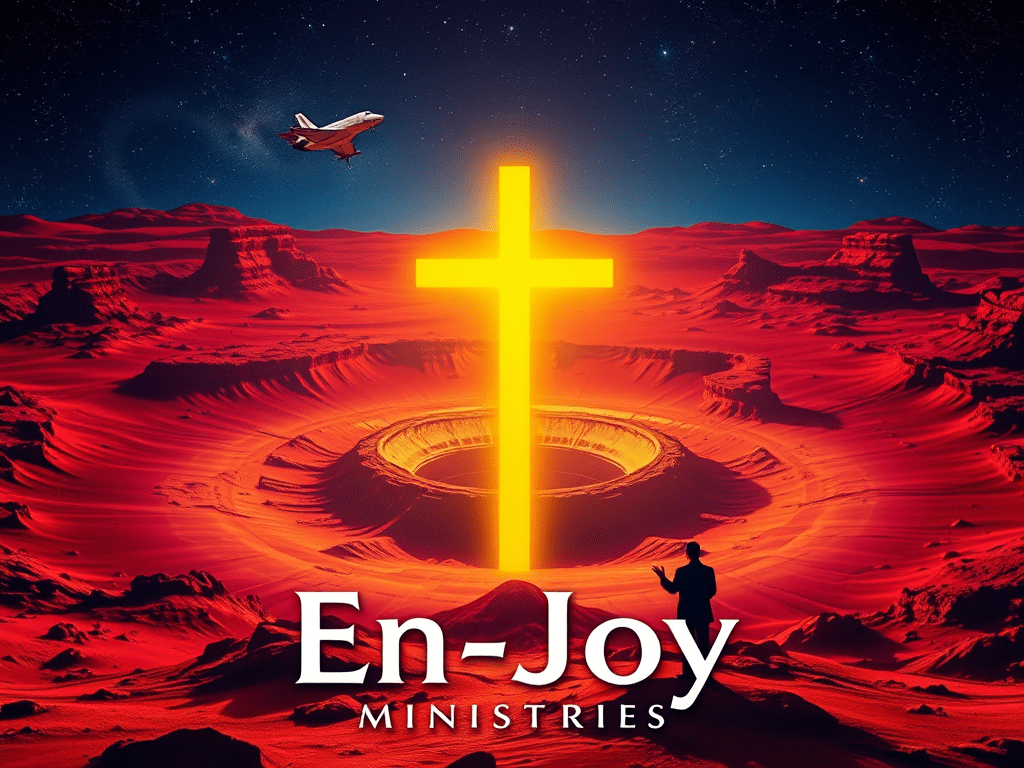
By Pastor Barron Greenwalt, En-Joy Ministries
As the pastor of En-Joy Ministries, I stand in awe of God’s creation, from the stars above to the intricate design of DNA. My love for space exploration, sparked by a behind-the-scenes tour of NASA’s Neutral Buoyancy Lab and a college research paper on the Strategic Defense Initiative (“Star Wars”), deepened my wonder at the Creator’s handiwork. Yet, as I reflect on scientific claims—like the idea that Mars’ Jezero Crater once held a lake of water billions of years ago—I’m compelled to view these through the lens of Scripture. As a young Earth creationist, I believe Genesis teaches that the Earth and universe are approximately 6,000–10,000 years old, a view shared by organizations like Answers in Genesis. I also hold that carbon dating and claims of billions of years are seriously flawed, pointing instead to the Bible’s truth. Through space exploration, I see God’s glory, and I pray it leads souls, including influential figures like Elon Musk, to the Savior, Jesus Christ, who died for all humanity—one race, descended from Adam and Eve.
The Bible, Mars, and the Flaws of Carbon Dating
Scientists, using NASA’s Perseverance and Curiosity rovers, suggest Mars’ Jezero Crater may have been a lake billions of years ago, implying a history incompatible with the biblical timeline. As a young Earth creationist, I believe the Earth and universe were created in six literal days, roughly 6,000 years ago, based on the genealogies of Genesis 5 and 11. Genesis 1:1 declares, “In the beginning, God created the heavens and the earth,” with no hint of billions of years. Secular science relies on methods like carbon dating or radiometric dating to claim ancient ages, but I believe these are seriously flawed. Carbon dating assumes constant decay rates and initial conditions that cannot be verified, and it often contradicts the Bible’s clear chronology. For example, volcanic rocks known to be recent have been dated to millions of years, exposing the method’s unreliability. The global Flood of Noah’s time (Genesis 6–9) further disrupts such dating, as it reshaped Earth’s geology and possibly Mars’ surface, which may explain features like Jezero Crater without requiring vast ages. Psalm 33:6 reminds us, “By the word of the Lord the heavens were made,” pointing to a recent, purposeful creation, not a billions-year-old cosmos.
Moreover, I find no biblical support for extraterrestrial life. Humanity, created in God’s image (Genesis 1:27), is unique, descending from Adam and Eve as one race (Galatians 3:28). The complexity of DNA—requiring enzymes and molecules to function simultaneously—demands a Creator’s instantaneous design, not evolutionary processes over eons. As Romans 1:20 states, “For his invisible attributes, namely, his eternal power and divine nature, have been clearly perceived, ever since the creation of the world, in the things that have been made.” Mars’ barren landscape and its gravity (3.71 m/s², 38% of Earth’s) declare God’s power, not a history of alien lakes or life.
The Space Shuttle Program: Humanity’s Reach, God’s Glory
The Space Shuttle program (1981–2011) showcased humanity’s God-given ingenuity under His sovereignty. It deployed the Hubble Space Telescope, revealing distant galaxies, and built the International Space Station, a marvel of engineering. The shuttle launched probes like Magellan to Venus and Galileo to Jupiter, expanding our view of God’s cosmos. Over 355 astronauts flew on 135 missions, reflecting the unity of humanity—one race in God’s image. Yet, the program’s cost (over $200 billion in today’s dollars) and tragedies like Challenger and Columbia remind us of our limits. Psalm 19:1 proclaims, “The heavens declare the glory of God,” and the shuttle’s feats point to the Creator, not human pride.
Mars vs. the Moon: Earth as God’s Focus
Some argue Mars exploration is more “cost-effective” than returning to the Moon, despite Mars’ distance (225 million km vs. the Moon’s 384,400 km). NASA’s Perseverance rover ($2.7 billion) is cheaper than Apollo’s $25 billion or Artemis’ $93 billion for lunar missions. But the real question is purpose. The Moon was a Cold War milestone, but Mars captivates as a “new frontier.” As a pastor, I see both as God’s creation, with Earth uniquely designed for life (Isaiah 45:18). Mars’ rovers, navigating its low gravity, reveal God’s artistry, but Scripture centers humanity on Earth, not distant planets.
Elon Musk, SpaceX, and a Prayer for Salvation
Elon Musk’s SpaceX, with its reusable Starship, dreams of Mars colonization. His vision inspires, but I believe he has not publicly professed faith in Christ. As a pastor, I pray Elon encounters the Savior. Romans 1:20 suggests creation reveals God, and I often say, “Follow the science, and it leads to God.” Mars’ craters and the cosmos’ order point to intelligent design. Imagine the global impact if Elon, with his influence, accepted Christ and proclaimed Him as Lord! His passion for space could become a platform to glorify the Creator, echoing Colossians 1:16: “For by him all things were created, in heaven and on earth, visible and invisible.”
Space Exploration: A Pastor’s Reflection
My love for space began in college, researching the Strategic Defense Initiative, and was deepened by a friend’s gift—a tour of NASA’s Neutral Buoyancy Lab, where I saw a replica of the space station. These experiences stirred awe at God’s creation, from the stars to the training pools mimicking weightlessness. Yet, as I reflect on Mars’ rovers or the shuttle’s legacy, I’m reminded of Ecclesiastes 3:11: “He has made everything beautiful in its time. Also, he has put eternity into man’s heart.” Space exploration stirs our longing for the eternal, but only Christ fulfills it.
For my congregation at En-Joy Ministries, I encourage you to marvel at Mars’ craters and the shuttle’s feats, but let them point you to Jesus, who died for all (John 3:16). As we explore the heavens, may we, like the psalmist, declare, “O Lord, our Lord, how majestic is your name in all the earth!” (Psalm 8:9). And may we pray for those like Elon Musk, that their journey through the stars leads to the cross.
Discover more from En-Joy Ministries
Subscribe to get the latest posts sent to your email.
