
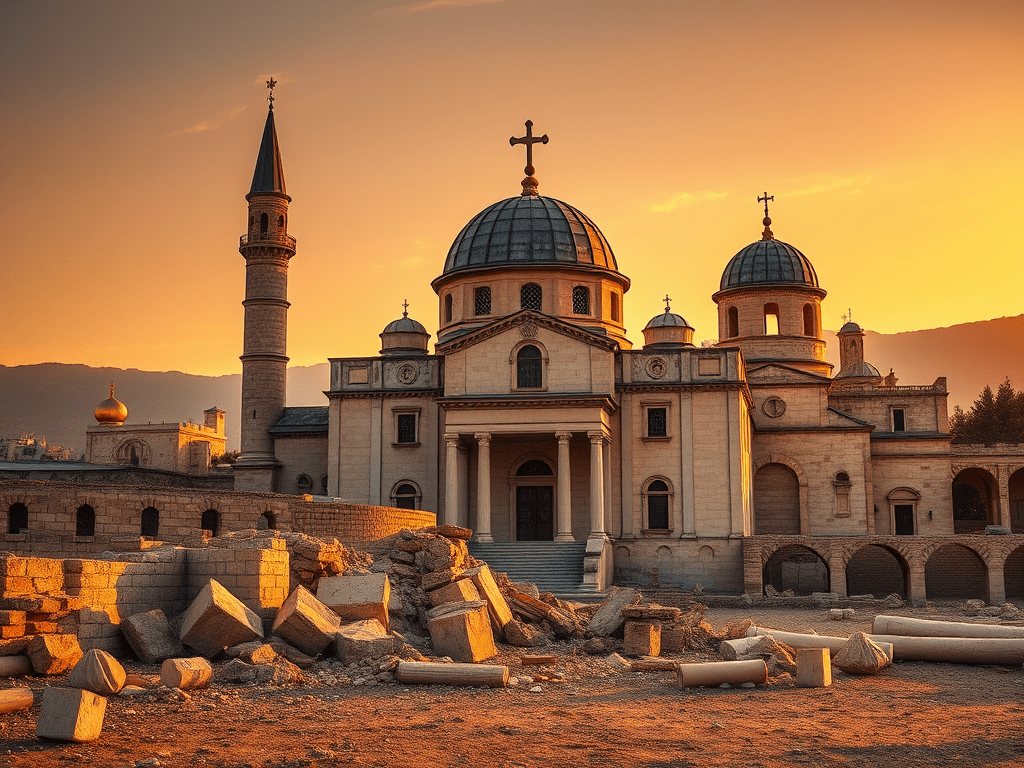
As a Christian, I’ve often found myself troubled by the direction our nation seems to be heading. Reading works like Marshall Foster’s American Covenant has deepened my appreciation for the United States’ Christian heritage—a foundation rooted in biblical principles that shaped our laws, culture, and identity. Yet, history reminds us that even nations with deep Christian roots can drift far from their faith. I recently learned that Syria, Turkey, Egypt, and Lebanon were once predominantly Christian nations, yet today, their Christian populations are mere shadows of their past. What happened to these cradles of Christianity? And could the United States be following a similar path? Let’s explore their stories, uncover biblical warnings, and consider how we, as American Christians, can remain a faithful remnant in an increasingly secular age.
The Christian Roots of the Middle East
The Middle East was once the heart of Christianity. Syria, home to Antioch, was where believers were first called Christians (Acts 11:26). It hosted vibrant churches and theological giants like John of Damascus. Turkey, as the Byzantine Empire’s core, was the epicenter of Eastern Christianity, with Constantinople as its crown jewel and the Seven Churches of Revelation (Revelation 2–3) dotting its landscape. Egypt’s Coptic Church, founded by tradition by St. Mark, made Alexandria a beacon of Christian thought, while Lebanon’s Maronite Christians carved out a stronghold in its rugged mountains, maintaining a Christian majority as late as the 1930s.
These nations weren’t just Christian outposts; they were the beating heart of the early church, where apostles preached, martyrs died, and creeds were forged. Yet today, Christians are a small minority in each: less than 1% in Syria, under 0.2% in Turkey, about 10–15% in Egypt, and roughly 32% in Lebanon. How did these Christian strongholds fade?
How They Strayed from Christianity
The decline of Christianity in these nations followed a centuries-long process, driven by common factors that reshaped their spiritual landscapes:
- Muslim Conquests: The 7th-century Arab conquests brought Syria and Egypt under Islamic rule, while the Ottoman Turks conquered Constantinople in 1453, absorbing Turkey and parts of Lebanon. These shifts established Muslim governance, setting the stage for gradual change.
- Economic and Social Pressures: Non-Muslims faced the jizya tax and legal disadvantages under Islamic rule. Conversion to Islam often brought social mobility, better jobs, and relief from financial burdens. Over generations, many Christians converted, especially in Egypt and Syria.
- Persecution and Violence: Periodic violence targeted Christians, from Ottoman massacres in the 19th century to the 1915–1923 Armenian, Greek, and Assyrian genocides in Turkey, which killed or displaced millions. In modern times, groups like ISIS have attacked churches in Syria and Egypt, further eroding Christian presence.
- Emigration: Conflicts and instability drove Christians away. The 1860 Druze-Christian clashes in Lebanon and Syria sparked early emigration waves, while Lebanon’s 1975–1990 civil war and Syria’s recent conflict pushed hundreds of thousands to flee. In Turkey, the 1923 population exchange with Greece expelled most Christians.
- Demographic Shifts: Higher Muslim birth rates and intermarriage gradually reduced Christian proportions. In Egypt, for example, Copts were a majority until the 12th century, but conversions and demographics tipped the balance.
These factors—conquest, pressure, violence, emigration, and demographics—created a slow but steady erosion of Christian identity, turning thriving churches into small, embattled minorities.
Is America Following the Same Path?
The United States, while not facing conquest or overt persecution, shows troubling parallels to these historical shifts. Our nation was founded on a Christian covenant, with leaders like John Winthrop envisioning a “city upon a hill” (Matthew 5:14). Yet, recent decades reveal a drift. Pew Research reports that the percentage of Americans identifying as Christian fell from 77% in 2009 to 65% in 2019, while the religiously unaffiliated (“nones”) rose to 26%. Secularism is reshaping our culture, with media, academia, and public policy often promoting values at odds with biblical teachings—whether on marriage, life, or truth itself.
Like the Middle East’s gradual assimilation, the U.S. faces cultural pressures that marginalize Christianity. Moral relativism and materialism act as modern “idols,” luring believers away from biblical fidelity. Many Christians disengage from church or public life, mirroring the withdrawal of Middle Eastern Christians under pressure. The Book of Judges offers a sobering parallel: “After that whole generation had been gathered to their ancestors, another generation grew up who knew neither the Lord nor what he had done for Israel” (Judges 2:10, NIV). Israel’s cycle of forgetting God led to idolatry and oppression. Are we, too, forgetting our covenant, raising a generation unfamiliar with the faith that built our nation?
Biblical Lessons and a Call to Action
Scripture warns us of the dangers of spiritual drift but also offers hope for renewal. Here are three lessons to guide us:
- Stand Firm in Faith: Paul urges believers to “put on the full armor of God, so that when the day of evil comes, you may be able to stand your ground” (Ephesians 6:13, NIV). Middle Eastern Christians faced pressures to conform; we face a culture that often mocks or marginalizes faith. We must equip ourselves with prayer, Scripture, and community to resist secular tides.
- Beware of Idolatry: John’s warning, “Dear children, keep yourselves from idols” (1 John 5:21, NIV), applies to modern America. Materialism, self-expression, and secular ideologies can replace God in our hearts, just as social incentives drew Middle Eastern Christians toward Islam. Let’s examine where we’ve placed our trust.
- Be a Faithful Remnant: Even when Israel strayed, God preserved a remnant: “I have reserved for myself seven thousand who have not bowed the knee to Baal” (Romans 11:4, NIV). The Copts in Egypt and Maronites in Lebanon endure as remnants despite decline. American Christians can be a remnant, faithfully living out their calling in a changing world.
So, what can we do? Engage in your local church, teach your children the faith, and boldly share the Gospel in public life. Speak truth with love, as Jesus did, even when it’s countercultural. Pray for revival, that America might return to its covenant with God.
Will We Be a Faithful Remnant?
The stories of Syria, Turkey, Egypt, and Lebanon remind us that Christian nations can lose their way—not overnight, but through gradual drift, pressure, and disengagement. The United States stands at a crossroads. Will we forget our Christian heritage, as Israel did in Judges, or will we stand firm, as Paul urged, and remain a faithful remnant, as God promised? The choice is ours. Let’s pray, act, and hold fast to the faith that has sustained nations and believers for centuries. Will you join me in being a light in this generation, ensuring America’s covenant endures?
Discover more from En-Joy Ministries
Subscribe to get the latest posts sent to your email.
