
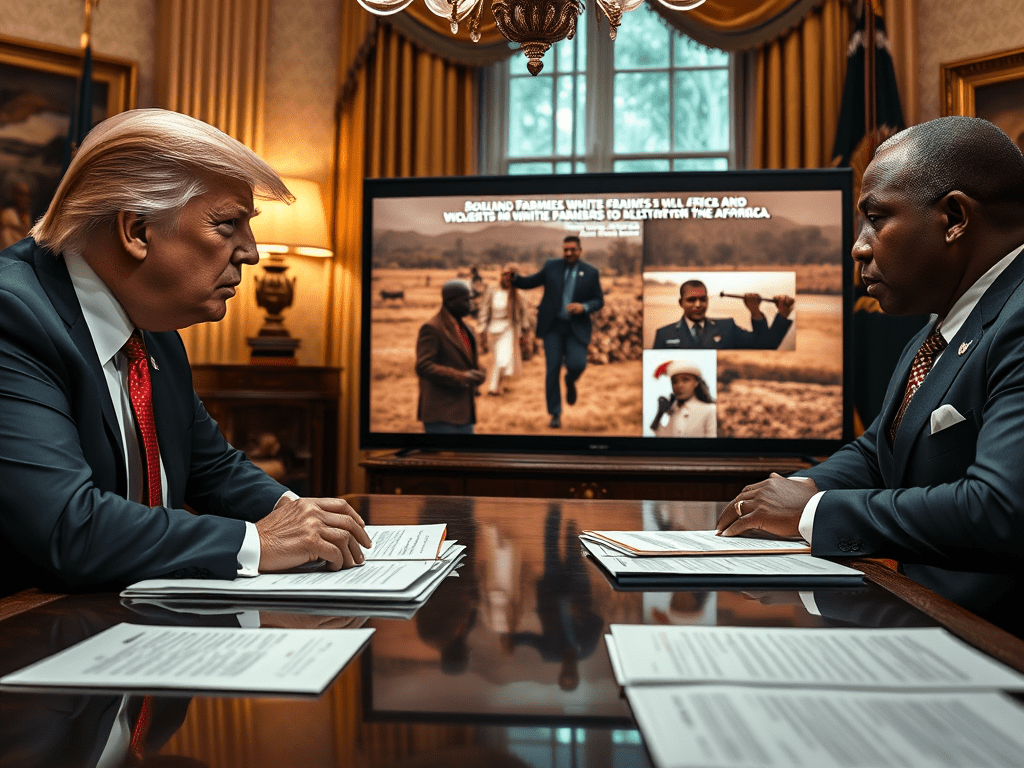
In an era where the label “warmonger” is often hurled at U.S. leaders, particularly past presidents and members of Congress, Donald Trump stands out as a figure who prioritizes peace through strength. Unlike predecessors who entangled the United States in costly and questionable wars, Trump’s presidency (2017–2021) was marked by no new military conflicts, a focus on diplomacy, and a demonstrated concern for human lives. Just this week, in a bold Oval Office meeting, Trump confronted South African President Cyril Ramaphosa with a video highlighting the killings of white farmers, underscoring his willingness to tackle human rights issues head-on. This post examines Trump’s peace-oriented record, contrasts it with the war-driven policies of the Bush, Obama, and Biden administrations, and highlights his consistent efforts to save lives through action and dialogue.
Trump’s Record: No New Wars, Historic Diplomacy
Donald Trump’s first term was a rare exception in modern U.S. history: a presidency that initiated no new wars. This is significant against the backdrop of the 20th century, where wars claimed an estimated 160 million lives, and post-World War II conflicts killed 23 million, with 90% of casualties being civilians—three-quarters of them women and children. Trump’s approach, rooted in economic leverage and diplomacy, avoided bloodshed while advancing U.S. interests.
The Abraham Accords of 2020 are a cornerstone of Trump’s legacy, normalizing relations between Israel and several Arab states, including the UAE, Bahrain, Sudan, and Morocco. These agreements reduced Middle East tensions through negotiation, not military force, showcasing Trump’s ability to broker peace. His meetings with North Korea’s Kim Jong-un and negotiations with the Taliban further demonstrated a preference for dialogue over conflict, even if controversial.
This week, Trump’s commitment to human rights was vividly displayed in a tense Oval Office meeting with South African President Cyril Ramaphosa. On May 21, 2025, Trump played a video montage, which he claimed showed evidence of violence against white South African farmers, and presented a document listing recently murdered Afrikaner farmers and their families. Sources report that Trump described the footage as showing “burial sites” and crosses marking murdered farmers, aiming to press Ramaphosa on the issue of farm attacks. While some outlets, like The New York Times and The Guardian, labeled Trump’s claims of “white genocide” as discredited or baseless, the gesture underscores his willingness to use direct, visual evidence to confront world leaders about human rights concerns. Regardless of the controversy, this action aligns with Trump’s broader pattern of addressing violence and instability through dialogue rather than intervention.
The Bush Administration: A War Built on Falsehoods
In contrast, George W. Bush’s presidency (2001–2009) is synonymous with the 2003 Iraq invasion, justified by claims of weapons of mass destruction (WMDs). No WMDs were found, as confirmed by the Iraq Survey Group in 2004, fueling accusations that the war was driven by ulterior motives, such as securing oil or awarding no-bid contracts to companies like Halliburton. The invasion cost over 100,000 Iraqi lives, 4,400 U.S. military deaths, and trillions of dollars, destabilizing the Middle East and contributing to the rise of ISIS.
The Bush administration’s response to 9/11 further illustrates its missteps. While al-Qaeda, based in Afghanistan, orchestrated the attacks, the U.S. invaded Iraq, a nation unconnected to 9/11. This diversion squandered resources and prolonged conflict, a far cry from Trump’s restraint and focus on targeted diplomacy.
Obama’s Legacy: Mixed Signals and Escalation
Barack Obama’s presidency (2009–2017) promised a departure from Bush’s policies but delivered mixed results. The 2011 Libya intervention, conducted without Congressional approval, toppled Muammar Gaddafi but left the country in chaos, fueling extremism and violence. Obama’s expansion of drone strikes, while reducing troop deployments, often resulted in civilian casualties, undermining his peace rhetoric.
The 2015 Iran nuclear deal (JCPOA) is another point of contention. The Obama administration released approximately $150 billion in frozen assets to Iran, including cash deliveries, to secure the agreement. Critics argue this empowered a regime known for sponsoring terrorism, raising questions about its impact on regional stability. Trump, by contrast, withdrew from the JCPOA in 2018, citing its flaws and imposing sanctions to pressure Iran economically rather than militarily.
Biden’s Reversal: Undermining Trump’s Policies
The Biden administration (2021–2024) has reversed several of Trump’s policies, often with destabilizing consequences. In 2021, Biden restored over $200 million in aid to the Palestinian Authority, which Trump had cut due to concerns about funds supporting terrorism. Critics argue this move, intended to promote stability, risks emboldening groups like Hamas, especially after the October 2023 attacks on Israel. Biden’s chaotic 2021 Afghanistan withdrawal, which left 13 U.S. service members dead and billions in equipment to the Taliban, further contrasts with Trump’s measured approach to de-escalation.
A Broader Perspective: The Cost of War and Genocide
The 20th century’s toll—160 million war deaths and 187 million lives lost to human intent, including genocide—highlights the stakes of leadership decisions. In Russia alone, archives document 60 million deaths from government actions, with half of male deaths from unnatural causes like war, famine, and execution. Since 1945, 250 major wars have killed 23 million, with civilians bearing the brunt. These figures underscore the need for leaders who prioritize peace.
Trump’s actions, from the Abraham Accords to his recent confrontation with Ramaphosa, reflect a commitment to addressing violence without resorting to war. His use of video evidence this week to highlight South African farm attacks, though controversial, demonstrates a willingness to tackle human rights issues directly, bypassing bureaucratic channels.
Conclusion: Trump’s Vision for Peace
Donald Trump’s record—free of new wars, marked by historic agreements like the Abraham Accords, and punctuated by bold actions like his recent meeting with Ramaphosa—sets him apart as a leader committed to peace through strength. In contrast, the Bush administration’s Iraq debacle, Obama’s Libya and Iran missteps, and Biden’s reversals of Trump’s policies highlight a pattern of unnecessary conflict and questionable priorities. In a world scarred by war and genocide, Trump’s approach—using diplomacy, economic leverage, and direct confrontation of human rights abuses—offers a path toward stability. As the global community grapples with ongoing violence, his vision for peace deserves recognition.
Discover more from En-Joy Ministries
Subscribe to get the latest posts sent to your email.
