
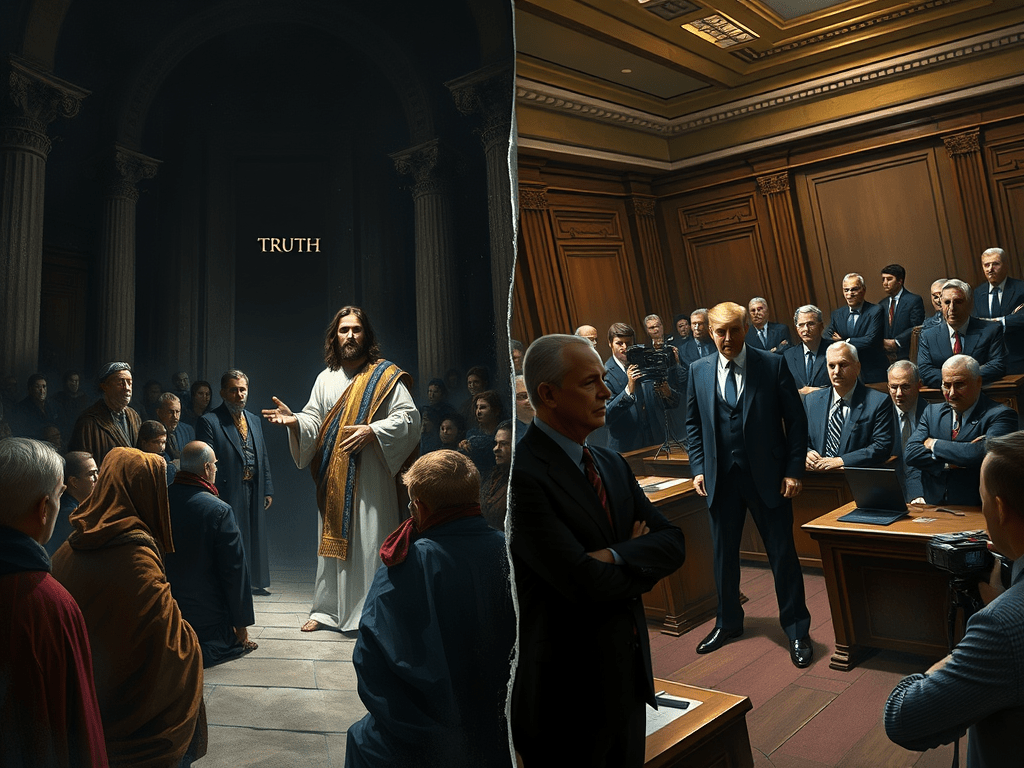
Introduction: A Trial Built on Lies
In the dim hours before dawn, a sham trial unfolded in Jerusalem. The Sadducees, the elite priests and aristocrats of the Jewish Sanhedrin, orchestrated a spectacle of injustice. Their target? Jesus of Nazareth, a teacher whose words shook their world. They twisted his teachings, suborned perjury, and silenced any defense. Their case was flimsy—witnesses couldn’t agree, evidence was nonexistent—but it didn’t matter. Behind closed doors, they bent the rules, declared him guilty, and sought his death. Their motive wasn’t justice but power, jealousy, and fear of losing control.
The Sadducees’ trial of Jesus, as recorded in Matthew 26:57–68 and Mark 14:53–65, wasn’t just a historical event—it’s a timeless warning. Their tactics of manipulation, suppression, and abuse of authority echo through history and into our world today. From corrupt legal systems targeting figures like Donald Trump to cultural gatekeepers silencing dissent, the Sadducees’ shadow lingers. Let’s explore their story, ask if any Sadducee ever turned to Jesus, and trace their modern parallels to uncover lessons for our time.
Who Were the Sadducees?
The Sadducees were the power brokers of first-century Judea. As temple priests and Sanhedrin members, they controlled religious and political life. Think of them as Congress and the Supreme Court rolled into one, wielding influence with an iron grip. Unlike the Pharisees, who believed in resurrection and oral traditions, the Sadducees rejected the afterlife, angels, and anything threatening their temple-based authority (Acts 23:8). They saw Jesus—a preacher of spiritual renewal and divine judgment—as a direct challenge to their status quo.
Their role in Jesus’ trial reveals their character. They didn’t seek truth; they sought control. They manipulated testimony, ignored justice, and rallied a mob to demand crucifixion (John 19:6–16). Yet, while Pharisees like Nicodemus and Paul eventually embraced Jesus, did any Sadducee ever follow him?
Did a Sadducee Ever Believe in Jesus?
The New Testament records no named Sadducee converting to faith in Jesus as the Messiah. Pharisees, with their messianic hopes, showed openness—Nicodemus defended Jesus and honored his burial (John 3:1–21, 19:39–42), and Paul, a former Pharisee, became a cornerstone of the early church (Acts 9:1–19). The Sadducees, however, remained steadfastly opposed. Their denial of resurrection clashed with Jesus’ teachings, and their temple wealth made his message of spiritual reform a threat (John 11:47–48).
One intriguing hint exists in Acts 6:7: “A large number of priests became obedient to the faith.” Since many Sadducees were priests, some scholars wonder if this included them. But the text doesn’t confirm it, and priests could mean non-Sadducean Levites. The Sadducees’ silence in conversion stories underscores their entrenchment, a cautionary tale of how power can blind us to truth.
The Sadducees’ End and Their Lasting Echoes
When the Romans destroyed the Jerusalem temple in 70 CE, the Sadducees’ world collapsed. Without their priestly power base, they vanished, unlike the Pharisees, whose traditions birthed Rabbinic Judaism. But while the Sadducees as a group disappeared, their archetype—elite, manipulative, and resistant to change—lives on. Their trial tactics, marked by secrecy, false accusations, and abuse of authority, find chilling parallels in modern power structures, especially in legal and cultural battles targeting figures like Donald Trump and others who challenge the status quo.
Modern Parallels: The Sadducees Among Us
The Sadducees’ shadow stretches across time, appearing in those who wield power to silence truth. Here are three modern parallels, with recognizable examples, that mirror their tactics:
- Corrupt Politicians and Legal Systems
The Sadducees’ sham trial resembles modern judicial corruption, where justice is twisted to serve power. Consider the legal battles against former President Donald Trump, which many view as politically motivated. His two impeachments—first over a Ukraine phone call in 2019 and then for alleged incitement on January 6, 2021—were criticized by supporters as baseless attempts to remove a duly elected leader, relying on partisan narratives rather than clear evidence of high crimes. The New York civil fraud lawsuit, accusing Trump of inflating Mar-a-Lago’s value by up to 2,300% (from $18–27.6 million to $426.5–612 million), has been called outlandish by real estate experts, given Mar-a-Lago’s status as a premier property. Critics argue the case, led by Attorney General Letitia James, exemplifies legal overreach to tarnish Trump’s reputation, much like the Sadducees’ flimsy charges against Jesus. Similarly, the treatment of January 6 defendants—many facing lengthy sentences for non-violent actions—has been decried as disproportionate, suggesting a judicial system weaponized against political dissenters. These cases echo the Sadducees’ use of legal mechanisms to suppress threats to their power.
- Cultural Gatekeepers and Cancel Culture
The Sadducees rallied mobs to shout “Crucify him!” (Matthew 27:22–23), a tactic echoed by modern cultural gatekeepers who manipulate public opinion to silence dissent. Trump’s legal woes are amplified by media narratives framing him as a threat, akin to the Sadducees’ mob tactics. The Masterpiece Cakeshop case, where baker Jack Phillips faced lawsuits and public shaming for refusing to create a cake for a same-sex wedding due to religious beliefs, illustrates how cultural elites can orchestrate campaigns to punish nonconformity. Despite Supreme Court rulings in Phillips’ favor (2018, 2023), ongoing litigation suggests a relentless effort to enforce ideological compliance, mirroring the Sadducees’ intolerance of Jesus’ teachings. Media moguls and social media platforms that “cancel” dissenting voices—such as deplatforming Trump post-January 6—further reflect this Sadducean strategy of silencing through public pressure.
- Abusive Institutional Leaders
Religious and corporate institutions can harbor Sadducean traits when leaders abuse authority to protect their image. The relentless legal pursuit of Trump—over 4,000 lawsuits before his presidency, including tax disputes and defamation cases—suggests an institutional vendetta, akin to the Sadducees’ fixation on eliminating Jesus. Scandals like the Catholic Church’s cover-up of clergy abuse or corporate malfeasance in the 2008 financial crisis show how elites prioritize power over truth. These institutions, like the Sadducees, bend rules to maintain control, leaving innocents to suffer, whether it’s January 6 defendants or small business owners like Phillips facing endless litigation.
These examples reveal a pattern: like the Sadducees, modern authorities manipulate systems, suppress truth, and prioritize power over justice. Their tactics—legalism, public shaming, or institutional cover-ups—persist as tools to silence voices challenging the establishment, from Jesus to Trump and beyond.
Reflection: What Can We Learn?
The Sadducees’ trial of Jesus challenges us to examine our world and ourselves. Are we complicit in systems that echo their tactics? Do we stand for truth when power seeks to suppress it? Here are two key lessons:
- A Case Study in Modern Persecution: Donald Trump and Beyond
The barrage of legal actions against Donald Trump—impeachments, the Mar-a-Lago lawsuit, and attempts to block his policies—bears striking parallels to the Sadducees’ tactics. Courts have issued over 200 injunctions against Trump’s moves in his second term’s first 100 days, compared to 64 in his entire first term, suggesting a concerted effort to obstruct his agenda. The New York fraud case, inflating Mar-a-Lago’s alleged overvaluation to justify a $454 million penalty, has been criticized as lacking victims or harmed parties, much like the Sadducees’ baseless charges. The January 6 defendants, often portrayed as insurrectionists despite many committing minor offenses, face harsh sentences, while Masterpiece Cakeshop’s Jack Phillips endures repeated lawsuits for his faith-based stance. These cases suggest a modern Sanhedrin—courts, media, and elites—working to silence those who challenge their authority. Yet, like Jesus’ resurrection, truth can prevail, as seen in Trump’s electoral resilience and Phillips’ legal victories.
- Hope in Redemption
Acts 6:7 offers hope: even some priests turned to faith, suggesting redemption is possible. We’re called to discern truth, speak boldly, and trust God’s justice, knowing Jesus triumphed over the Sadducees’ schemes. Whether facing legal battles or cultural pressure, we can stand firm, inspired by those who resist modern Sadducean tactics.
Call to Action
Reflect: Who are the “Sadducees” in your world—those manipulating truth for power? How can you, like Jesus, stand firm in truth? Share this post, discuss it with your community, and commit to seeking justice in a world still shadowed by the Sadducees’ tactics.
Discover more from En-Joy Ministries
Subscribe to get the latest posts sent to your email.
