
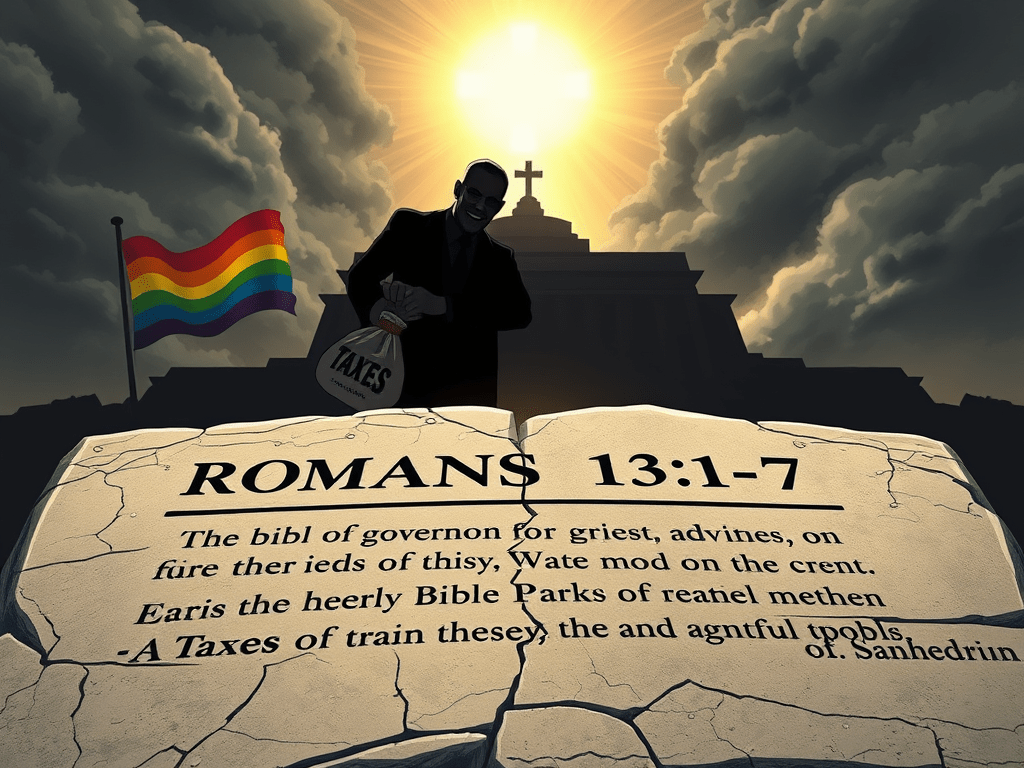
As Christians, we hold the Bible as the absolute truth, a divine guide for navigating life’s complexities. Yet, passages like Romans 13:1-7, which instructs believers to “submit to governing authorities,” can feel like a stumbling block when governments embrace policies and actions that defy God’s precepts. Recent revelations from the Department of Government Efficiency (DOGE), led by Elon Musk, expose systemic corruption, including the weaponization of the Department of Justice (DOJ) against Christians and the misuse of our taxes to fund evil and enrich the corrupt. Cases like Masterpiece Cakeshop v. Colorado Civil Rights Commission, the redefinition of marriage, the promotion of the LGBTQ movement, unconstitutional voting practices, affirmative action, and the DEI (Diversity, Equity, Inclusion) movement raise serious questions: How can believers submit to a government that rejects God’s moral order? By examining Romans 13 in its biblical and historical context, alongside other scriptures and narratives, we can discern when submission turns into complicity and why resistance to corrupt authority aligns with our faith.
The Context of Romans 13:1-7
Romans 13:1-7 is often cited to advocate unquestioning obedience to government. The passage states that “there is no authority except that which God has established” and that rulers are “God’s servants” to reward good and punish evil. On the surface, it appears to demand absolute submission, but this interpretation falters when we consider the broader biblical narrative and the historical context in which Paul wrote.
Paul penned Romans during the mid-50s AD, under the Roman Empire, a regime often corrupt and hostile to Christians. The emperor Nero, who later persecuted Christians brutally, was in power. Paul himself faced imprisonment and ultimately martyrdom for his faith (2 Corinthians 11:23-27). If Romans 13 mandated blind obedience, Paul’s own actions—preaching the gospel despite bans (Acts 5:27-29)—would contradict his teaching. Instead, Paul is describing the ideal role of government as God’s delegated authority to maintain justice and order, not endorsing every action of every ruler. The text assumes authorities act as “servants for good” (Romans 13:4). When they do the opposite—promoting evil and punishing good—their legitimacy is undermined.
Biblical Examples of Resistance to Unjust Authority
Scripture is replete with examples of God’s people resisting corrupt authorities when obedience would violate God’s commands. These narratives clarify that submission to government is not absolute:
- The Hebrew Midwives (Exodus 1:15-21): When Pharaoh ordered the midwives to kill Hebrew baby boys, they disobeyed, fearing God more than the king. God blessed their defiance, showing that obedience to Him supersedes human authority.
- Daniel and His Friends (Daniel 3, 6): Shadrach, Meshach, and Abednego refused to bow to Nebuchadnezzar’s idol, and Daniel continued praying to God despite a decree forbidding it. Their actions demonstrate that when government demands idolatry or prohibits worship, resistance is required.
- Peter and John (Acts 5:29): When the Sanhedrin ordered the apostles to stop preaching Jesus, they declared, “We must obey God rather than human beings!” Their defiance was not rebellion for rebellion’s sake but a commitment to God’s higher authority.
These examples show that when human authority commands sin or forbids righteousness, believers are called to obey God, even at great personal cost. Romans 13 cannot mean unconditional submission when such submission contradicts God’s law.
The Sanhedrin: A Historical Parallel to Modern Corruption
In Jesus’ day, the Sanhedrin was the Jewish governing council, wielding both religious and political authority under Roman oversight. Comprised of priests, elders, and scribes, it was the equivalent of today’s Supreme Court justices and congressmen combined—a body meant to uphold God’s law but often corrupted by power and compromise. The Sanhedrin’s trial of Jesus (Matthew 26:57-66; Luke 22:66-71) was a mockery of justice, violating multiple Mosaic laws, including prohibitions on nighttime trials and using a defendant’s testimony against him (Mishnah, Sanhedrin 4:1; Yevamot 25b:2). Their hatred for Jesus led them to collude with Rome to execute the Messiah, fulfilling their own corrupt agenda.
This historical parallel is striking when we consider modern governance. Just as the Sanhedrin abused its authority, today’s institutions—courts, legislatures, and executive agencies—often prioritize ideology over justice. The weaponization of the DOJ during the Obama administration, targeting Christians like Jack Phillips of Masterpiece Cakeshop, echoes the Sanhedrin’s persecution of those who upheld God’s truth. Phillips, a Christian baker, was sued for declining to create a cake for a same-sex wedding, citing his religious convictions. The Supreme Court ruled 7-2 in his favor in 2018, recognizing that the state showed “clear and impermissible hostility” toward his faith. Yet, Phillips faced ongoing litigation, highlighting how governments can harass believers under the guise of law.
Contemporary Issues and Government Rejection of God’s Precepts
The tension between Romans 13 and modern governance intensifies when we examine policies and cultural shifts that defy biblical principles, particularly in light of DOGE’s revelations about government corruption:
- Misuse of Taxpayer Money: Romans 13:6 instructs believers to pay taxes to support legitimate governance, but DOGE’s findings expose a betrayal of this principle. Our taxes—extracted under threat of imprisonment, tax liens, or crippling IRS fines and interest—are being robbed to fund evil and enrich corrupt officials. DOGE has uncovered how government funds are misused to support agendas contrary to God’s law, such as promoting unbiblical ideologies or bankrolling projects that benefit the powerful at the expense of the righteous. This coercive taxation, enforced by the very representatives who claim to serve us, echoes Jesus’ condemnation of those who “devour widows’ houses” (Mark 12:40) while pretending to uphold justice. When our money is stolen to advance wickedness, submission to such authority becomes complicity in sin.
- Redefinition of Marriage and the LGBTQ Movement: In 2015, the Supreme Court’s Obergefell v. Hodges decision legalized same-sex marriage, redefining a God-ordained institution (Genesis 2:24; Matthew 19:4-6). The government’s embrace of the LGBTQ movement, including pride flags on public buildings, often pressures Christians to affirm ideologies contrary to scripture (1 Corinthians 6:9-11). This mirrors the Sanhedrin’s imposition of man-made traditions over God’s law (Mark 7:8-13).
- Weaponization of the DOJ: Reports from DOGE and other sources reveal how the DOJ has targeted Christians and conservatives, from IRS scrutiny of religious organizations during the Obama years to FBI surveillance of pro-life activists. Such actions recall Psalm 94:20: “Can a corrupt throne be allied with you—a throne that brings on misery by its decrees?”
- Unconstitutional Voting Practices: Allegations of non-citizens voting in elections undermine the rule of law, eroding trust in governance. A government that fails to uphold justice loses its moral claim to submission.
- Affirmative Action and DEI: Policies like affirmative action and DEI, while promoted as equitable, can discriminate by prioritizing race or identity over merit, contradicting Galatians 3:28, which declares equality in Christ. These initiatives often reflect secular ideologies that elevate human standards above God’s.
When governments enact “unrighteous decrees” (Isaiah 10:1-2) or “devise evil by law” (Psalm 94:20), they forfeit their role as God’s servants. Christians must discern when submission enables injustice and when resistance is a faithful response.
A Nuanced Reading of Romans 13
A careful reading of Romans 13 reveals that Paul’s command is not absolute. The passage describes government’s intended function: to punish evil and reward good. When authorities do the opposite—punishing the righteous, rewarding the wicked, or robbing citizens to fund evil—they act outside God’s design. Theologian Francis Schaeffer argued, “God has ordained the state as a delegated authority; it is not autonomous. When it does the reverse, it has no proper authority. It is then a usurped authority and as such it becomes lawless and is tyranny.”
James Scott’s theory of “hidden transcripts” offers a fresh perspective, suggesting Paul’s words in Romans 13 may subtly resist empire. By calling rulers “servants” (diakonos), Paul reminds them they are accountable to God, not autonomous gods. This aligns with Romans 12:9, which urges believers to “hate what is evil; cling to what is good.” Resistance to evil laws, then, is not rebellion against God but fidelity to Him.
Practical Responses to Corrupt Government
So, how should Christians respond to a government that rejects God’s precepts and misuses our taxes to fund evil? Here are biblically grounded principles:
- Obey God Over Man (Acts 5:29): When laws require sin or forbid righteousness, believers must prioritize God’s commands. This may mean refusing to affirm unbiblical ideologies or participating in unjust systems.
- Engage in Civil Disobedience When Necessary: Figures like Martin Luther King Jr., Rosa Parks, and Dietrich Bonhoeffer resisted unjust laws not as rebels but as faithful Christians. Their actions aligned with biblical calls to seek justice (Micah 6:8).
- Use Democratic Freedoms: In a democracy, Christians can vote, advocate, and speak out against injustice, including the misuse of taxpayer funds, acting as “salt and light” (Matthew 5:13-16). This includes challenging policies like DEI or unconstitutional voting practices through legal and political means.
- Pray for Authorities (1 Timothy 2:1-3): Prayer for leaders, even corrupt ones, invites God’s intervention and aligns our hearts with His will.
- Trust God’s Sovereignty: Daniel 2:21 reminds us that God “sets up kings and deposes them.” Even corrupt governments are under His providence, and He will ultimately judge their actions (Romans 3:19).
Conclusion: Standing Firm in Faith
Romans 13:1-7 calls Christians to respect God-ordained authority, but it does not demand blind obedience to corrupt governments that defy God’s precepts. The Sanhedrin’s betrayal of justice in Jesus’ trial mirrors modern institutions that weaponize power against believers and rob our taxes to fund evil. Cases like Masterpiece Cakeshop, the redefinition of marriage, the DOJ’s targeting of Christians, and DOGE’s exposure of misused funds reveal a government often at odds with biblical truth. As believers, we must discern when submission becomes complicity and when resistance is a faithful stand for God.
Like Daniel, Peter, and the Hebrew midwives, we are called to obey God above man, trusting His sovereignty while actively opposing injustice. Let us pray for wisdom, speak truth boldly, and live as witnesses to Christ’s lordship, knowing that “the authorities that exist” are ultimately subject to the King of Kings (Revelation 19:16).
Discover more from En-Joy Ministries
Subscribe to get the latest posts sent to your email.
