
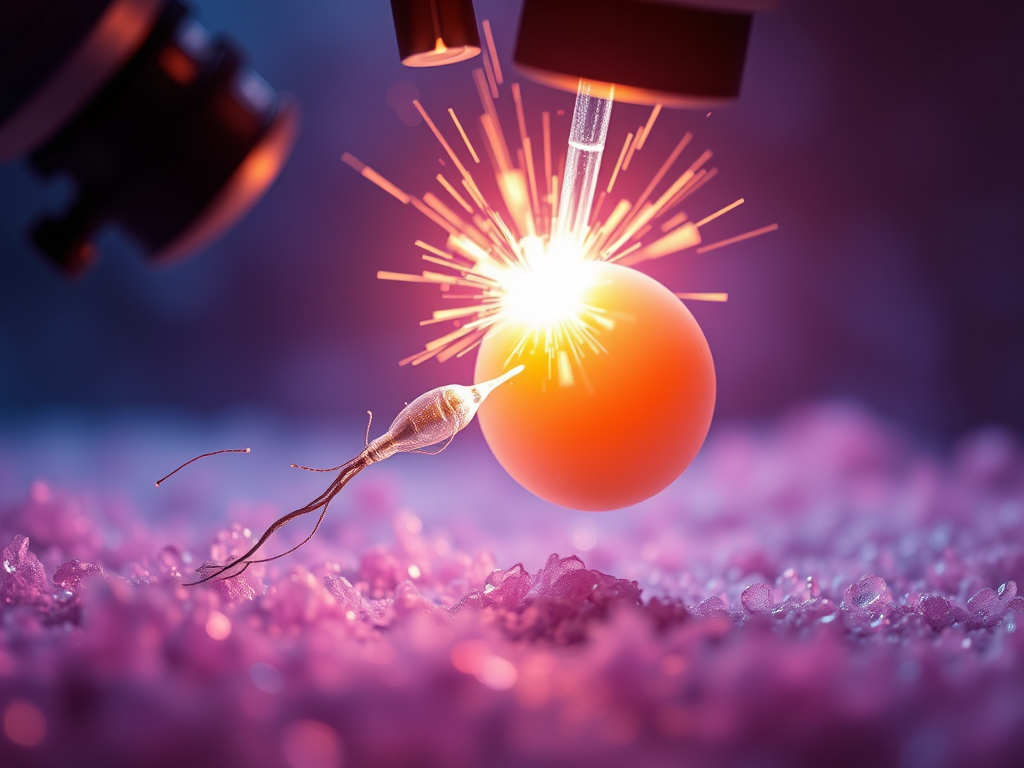
As a Christian, I am continually amazed by how the natural world reveals the fingerprints of our Creator. Recently, I came across a fascinating post on X that described a “spark of light” observed at the moment of fertilization in laboratory settings. This phenomenon, known as the zinc spark, is not a mystical glow but a biochemical event—a release of zinc ions visualized with fluorescent probes under specialized equipment. Far from diminishing the miracle of life, this scientific discovery deepens my awe of God’s intelligent design. As the great astronomer Galileo Galilei is often quoted as saying, “Science tells us how the heavens go; the Bible tells us how to go to heaven.” Science and faith are not at odds—they illuminate each other, revealing the grandeur of God’s creation.
The Science of the Zinc Spark
When a sperm meets an egg, an extraordinary process unfolds. Scientists have observed that, at the moment of fertilization, the egg releases billions of zinc ions in a rapid, coordinated burst. This zinc spark is a critical biochemical signal, helping to regulate the early stages of embryonic development. In laboratory settings, researchers use fluorescent probes—molecules that glow under specific wavelengths of light—to visualize this zinc release. Under a microscope, the event appears as a fleeting burst of fluorescence, a “spark” that marks the beginning of a new life.
This phenomenon has been documented in mammalian eggs, including those of humans, mice, and other species. The zinc spark is not visible to the naked eye; it requires sophisticated imaging technology to detect. Yet its discovery is a testament to the precision and complexity of life’s earliest moments. The zinc ions play a role in hardening the egg’s outer membrane, preventing additional sperm from entering, and they help activate the genetic machinery that guides the embryo’s growth. It’s a process so intricate, so perfectly orchestrated, that it points to a purposeful intelligent design.
The Biblical Narrative: Light and Life
The zinc spark, though a scientific observation, evokes a profound spiritual resonance. In the Bible, light is a powerful symbol of God’s presence and creative power. The very first act of creation in Genesis declares, “And God said, ‘Let there be light,’ and there was light” (Genesis 1:3, NIV). This divine light brought order to the formless void, setting the stage for all life. Similarly, the spark of light at fertilization signals the beginning of a new human life, a sacred moment where God’s creative hand is at work.
The Gospel of John further connects light with life, proclaiming, “In him was life, and that life was the light of all mankind” (John 1:4, NIV). The zinc spark, seen through the lens of faith, becomes a metaphor for the divine spark of life bestowed by God. Each new life begins with a burst of activity, a glimmer that echoes the Creator’s command to “be fruitful and multiply” (Genesis 1:28, NIV). Science reveals the how—the biochemical mechanisms—but faith reveals the why: every life is a purposeful act of God’s love.
Science and Faith in Harmony
Some may argue that scientific explanations reduce the miracle of life to mere chemistry. But I believe the opposite is true. The more we uncover about the natural world, the more we see the brilliance of God’s design. The zinc spark is not a random occurrence but a finely tuned process, one of countless mechanisms that must align perfectly for life to begin. As Psalm 139:14 declares, “I praise you because I am fearfully and wonderfully made; your works are wonderful, I know that full well.” The complexity of the zinc spark only enhances my sense of wonder, pointing to a Creator who wove such precision into the fabric of existence.
Galileo’s wisdom reminds us that science and faith serve complementary purposes. Science explores the mechanics of God’s creation—how the stars move, how cells divide, how zinc ions spark at fertilization. The Bible, meanwhile, guides us toward the Creator Himself, teaching us how to live in relationship with Him. To “follow the science,” as the saying goes, is not to abandon faith but to trace the evidence back to its source. Time and again, I find that science leads me to God, revealing His handiwork in ways that inspire awe rather than doubt.
A Call to Wonder
The discovery of the zinc spark is a reminder that God’s miracles are not confined to the pages of scripture—they unfold before us in the laboratory, under the microscope, and in the quiet moments of creation. Each spark of light at fertilization is a testament to the sanctity of life, a fleeting glimpse of the divine artistry that shapes every human soul. As we marvel at these scientific insights, let us also lift our hearts in worship, echoing the words of Job: “The Spirit of God has made me; the breath of the Almighty gives me life” (Job 33:4, NIV).
So, let us embrace both science and scripture, allowing each to cast light on the other. Let us follow the science, not with skepticism, but with expectation, knowing that it will lead us closer to the God who spoke light into being. The zinc spark is more than a biochemical event—it is a whisper of the Creator’s voice, a spark of His eternal light shining in the miracle of life.
Scientific Accuracy: The explanation of the zinc spark is based on documented research, such as studies published in journals like Nature Chemistry (e.g., Duncan et al., 2016), which describe the zinc release at fertilization in mammalian eggs. The process is visualized using fluorescent probes, and its role in embryonic development is well-established.
Discover more from En-Joy Ministries
Subscribe to get the latest posts sent to your email.
