
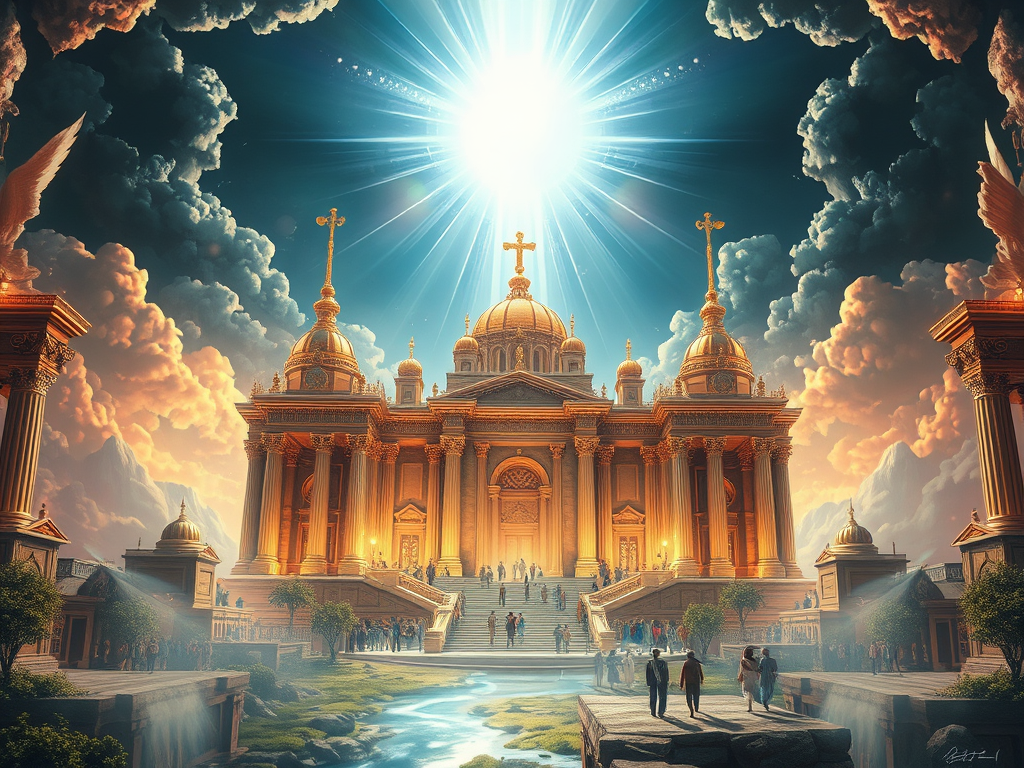
The Bible consistently presents heaven as a tangible destination, not just an abstract state. Here’s how it’s described as a “place” based on several verses and key biblical themes:
- A Dwelling with Structure
- John 14:2-3: Jesus says, “In My Father’s house are many mansions… I go to prepare a place for you.” The Greek words topos (place) and monai (dwelling places) suggest a physical location with room for individuals—a house or estate with accommodations. It’s not vague; it’s a prepared, inhabitable space.
- Revelation 3:12: The “New Jerusalem, which comes down out of heaven,” is depicted as a city with a temple, pillars, and names inscribed—implying architectural features. Revelation 21 (from your later list) adds details like gates, walls, and a throne, reinforcing a structured environment.
- Implication: Heaven is a real locale with spatial qualities, not just a spiritual ether.
- God’s Throne Room
- Mark 16:19: Jesus “was received up into heaven and sat down at the right hand of God,” positioning heaven as the seat of divine rule—a throne room of cosmic authority.
- Hebrews 9:24: Christ enters “heaven itself” to appear “in the presence of God,” contrasting it with earthly “holy places made with hands.” It’s the ultimate sanctuary where God resides.
- Broader Context: Isaiah 6:1 (“I saw the Lord sitting on a throne, high and lifted up”) and Revelation 4:2 (“a throne set in heaven”) solidify heaven as God’s regal headquarters.
- Implication: Heaven is a place of governance, centered around God’s presence and power.
- A Destination Above
- Thessalonians 4:17: Believers are “caught up… in the clouds to meet the Lord in the air,” suggesting heaven is spatially elevated, distinct from earth. The language of ascent recurs—Jesus “ascends” (Mark 16:19), “passes through the heavens” (Hebrews 4:14).
- Luke 2:14: “Glory to God in the highest” places heaven as the “highest” realm, above all earthly domains.
- Broader Context: Genesis 1:1 distinguishes “the heavens and the earth,” and Acts 1:9-11 shows Jesus lifted “up” into a cloud, reinforcing heaven’s upward orientation.
- Implication: Heaven exists as a higher plane, physically and metaphysically separate from earth.
- A Prepared Homeland
- Hebrews 11:16: The faithful seek “a better, that is, a heavenly country,” and God “has prepared a city for them.” It’s a homeland (patrida)—a place of belonging, distinct from the temporary “pilgrim” status on earth.
- Exodus 15:13: God leads His people to His “holy habitation,” which, while possibly earthly in context (like Canaan), typifies heaven as the ultimate destination of redemption.
- Implication: Heaven is a purposeful, permanent residence for God’s people, not a transient stop.
- A Place of Transformation
- Revelation 3:12: The New Jerusalem descends “out of heaven,” and overcomers become “pillars” in God’s temple, suggesting a dynamic place where identities are renewed.
- Thessalonians 4:16-17: The resurrection and gathering “in the air” indicate heaven as a site of cosmic events—where the dead rise and the living are transformed (cf. 1 Corinthians 15:52).
- Implication: Heaven isn’t static; it’s a place where God’s redemptive work culminates.
How Heaven Differs from Other Places
Heaven stands apart from earthly and other spiritual realms in several striking ways:
- Uncreated and Eternal vs. Created and Temporary
- Unlike earth, which Genesis 1:1 says was “created,” heaven is often implied as pre-existent with God (e.g., “the heavens” exist from the beginning). Hebrews 9:24 calls earthly sanctuaries “copies of the true,” while heaven is the original, enduring reality.
- Earth passes away (Revelation 21:1), but heaven—or its renewed form, the New Jerusalem—persists eternally (Revelation 22:5).
- Difference: Heaven’s timelessness contrasts with earth’s decay and impermanence.
- Sinless Purity vs. Sin’s Corruption
- Heaven is where God dwells in unapproachable holiness (Hebrews 9:24), free from sin’s taint. Revelation 21:27 (from your later list) says, “nothing impure will ever enter it.”
- Earth, by contrast, is marred by sin (Romans 8:20-22), and even earthly temples required constant purification (Hebrews 9:23). Hell, another “place,” is defined by rebellion and punishment (Matthew 25:41).
- Difference: Heaven’s purity sets it apart from every flawed or fallen domain.
- Direct Divine Presence vs. Mediated Access
- In heaven, God and Christ are immediately present—Jesus sits at God’s right hand (Mark 16:19), and believers will “always be with the Lord” (Thessalonians 4:17). Revelation 22:4 promises “they shall see His face.”
- On earth, God’s presence was veiled (e.g., in the tabernacle, Exodus 15:13’s “holy habitation”) or mediated through priests and prophets. Other places, like Sheol or Hades, lack God’s redemptive presence entirely.
- Difference: Heaven offers unhindered communion with God, unlike the separation or distance elsewhere.
- Abundance and Perfection vs. Limitation
- John 14:2’s “many mansions” and Hebrews 11:16’s “better country” suggest vastness and sufficiency, free of scarcity. Revelation 21:4 (from your later list) adds no death, sorrow, or pain—perfection is realized.
- Earth is finite, plagued by want and suffering (Genesis 3:17-19). Even paradises like Eden were lost to sin, while heaven’s perfection is secure.
- Difference: Heaven’s boundless provision and flawlessness outshine every other place.
- Exalted and Sovereign vs. Subordinate Realms
- Heaven is “the highest” (Luke 2:14), above all powers (Ephesians 1:20-21, from your later list). It’s the source of the New Jerusalem (Revelation 3:12), not subject to anything below.
- Earth and other realms (e.g., “under the earth,” Philippians 2:10) are subordinate, created, or judged by heaven’s authority.
- Difference: Heaven’s supremacy distinguishes it as the ultimate place of rule.
Summary
The Bible describes heaven as a real, structured place—a divine throne room, a prepared city, a higher homeland—marked by holiness, eternity, and God’s immediate presence. It differs from other places by being sinless, abundant, and sovereign, surpassing earth’s temporality, corruption, limitations, and the punishment or emptiness of realms like hell. Its uniqueness lies in its role as the perfected, eternal dwelling where God and His redeemed unite.
When people express worries about going to heaven and living there eternally, their concerns often stem from a mix of personal fears, cultural influences, and assumptions about what heaven might be like. Since the Bible, including the verses in our lesson, paints heaven as a place of divine perfection and eternal communion with God, these worries typically arise not from scripture itself but from human imagination or misunderstandings. Let’s explore some common concerns and the assumptions behind them, then tie them back to biblical descriptions for clarity.
Discover more from En-Joy Ministries
Subscribe to get the latest posts sent to your email.
